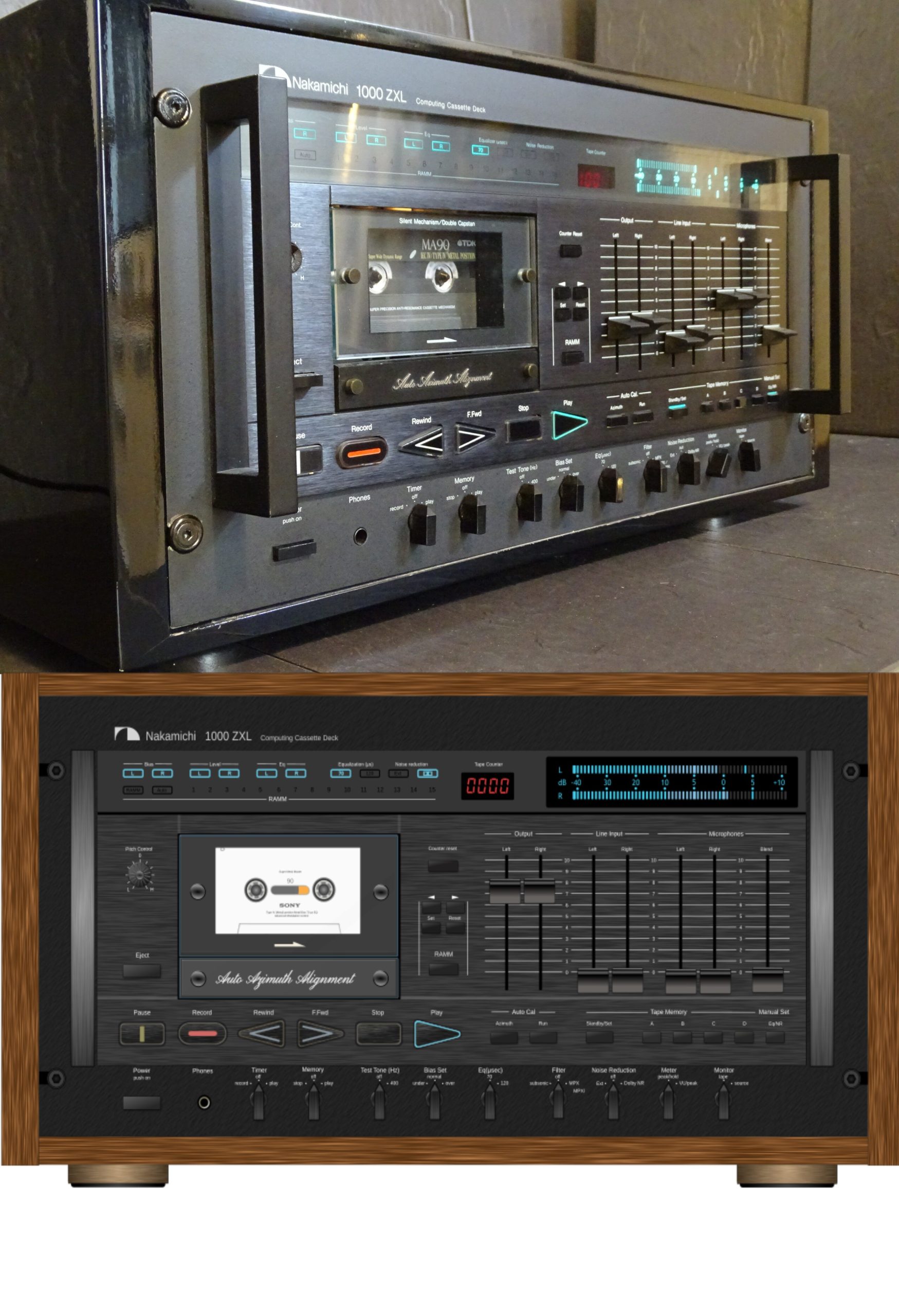
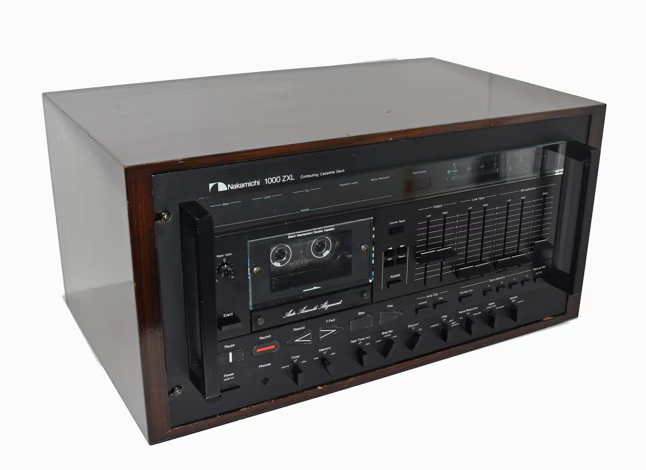
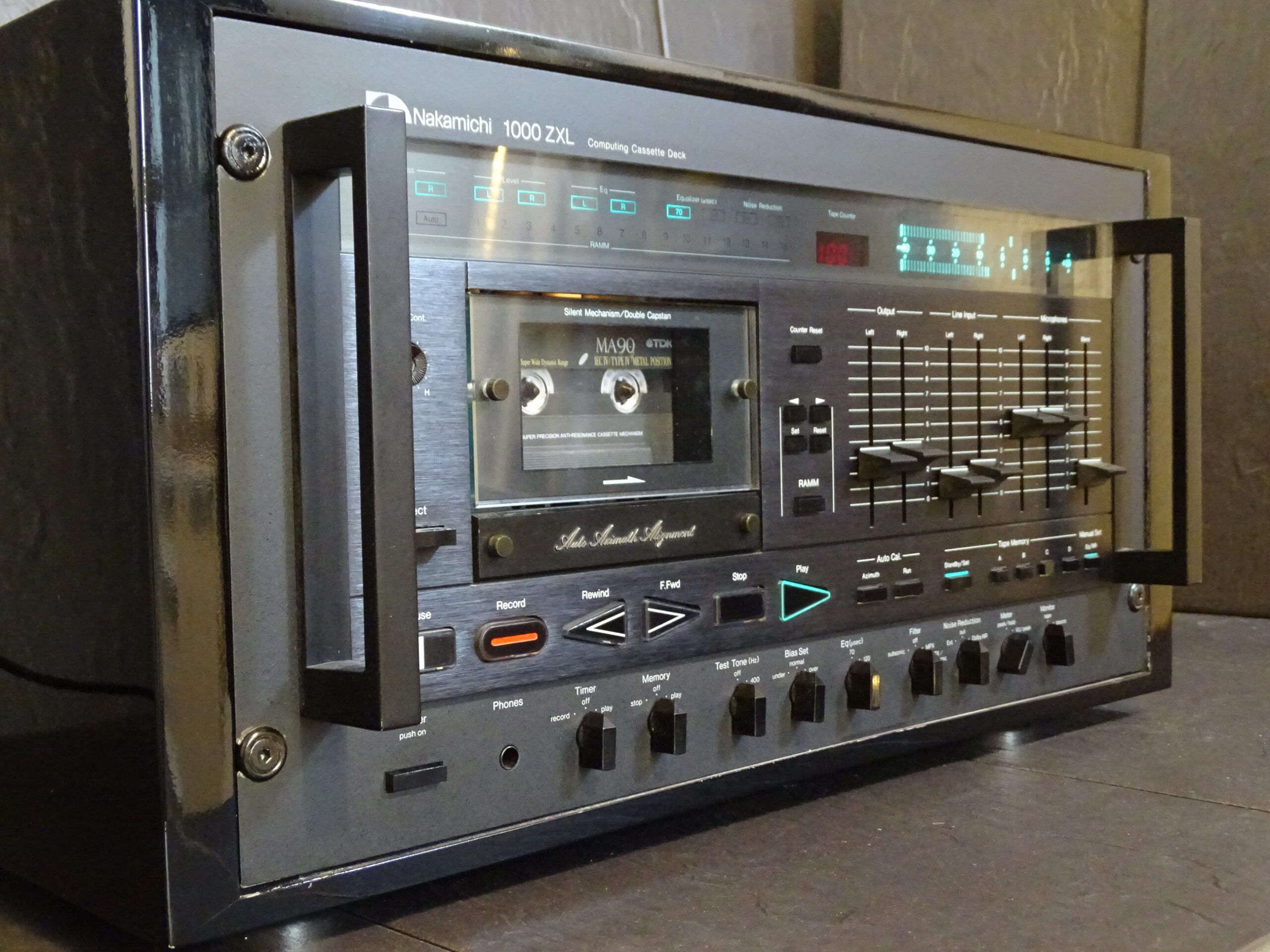
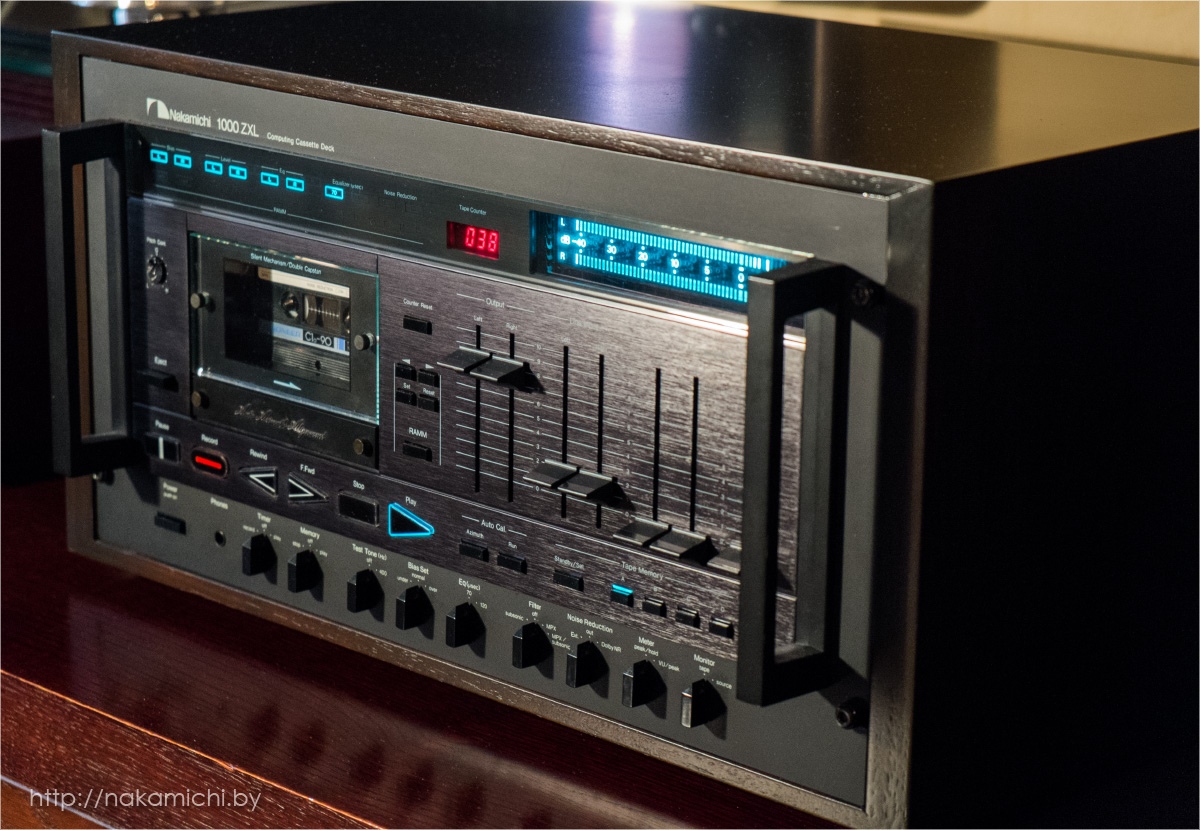
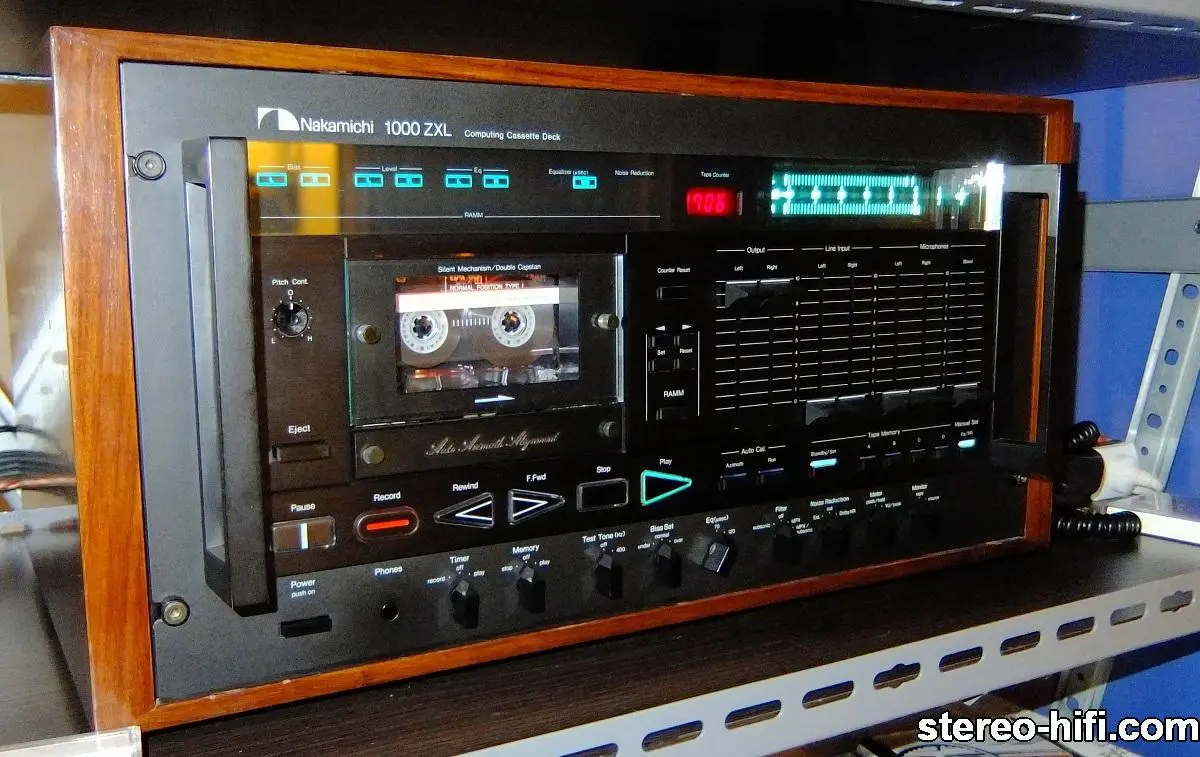
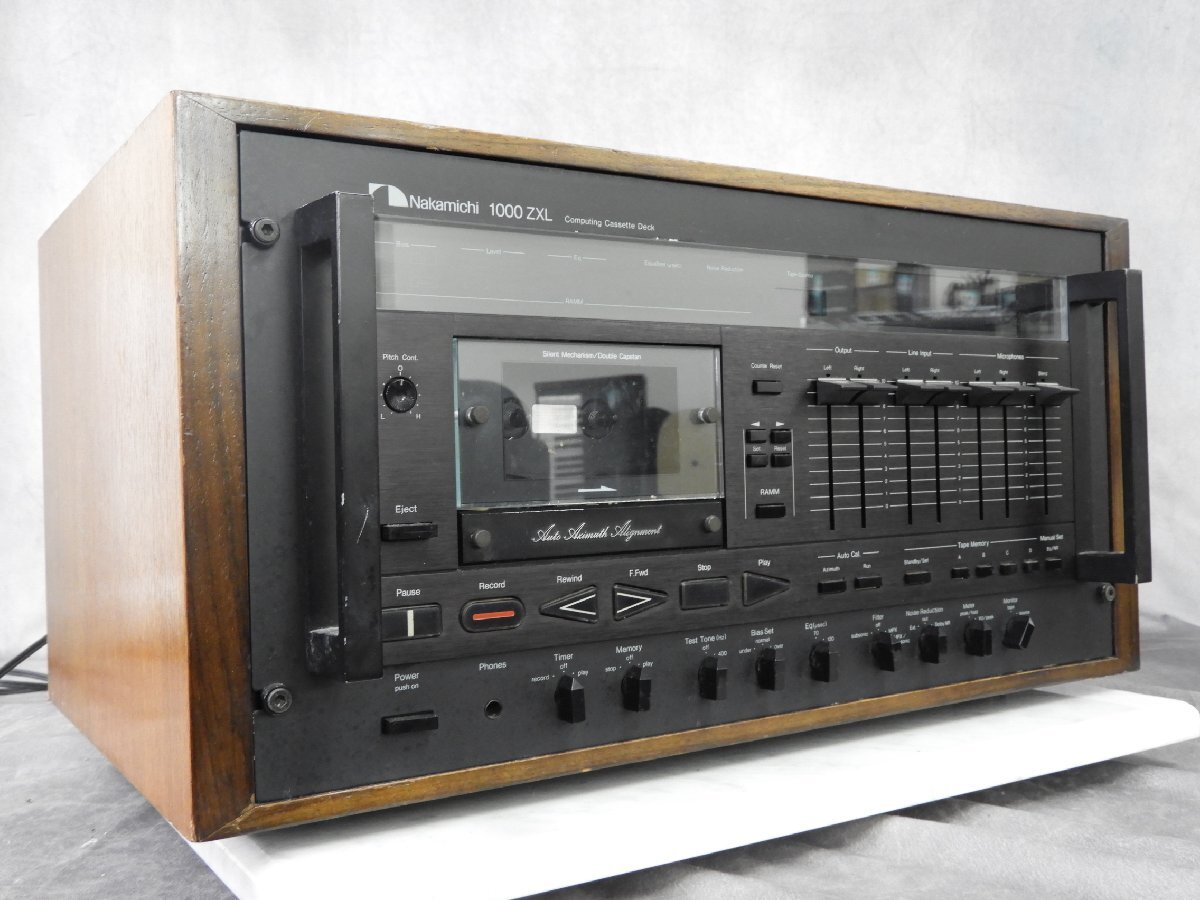
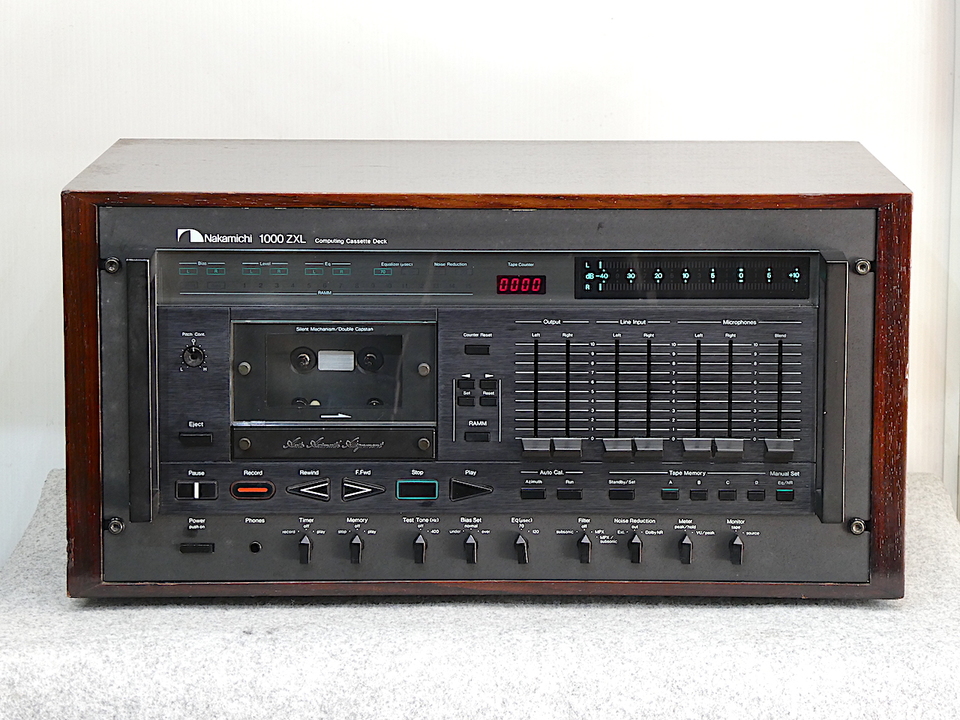
The Nakamichi 1000ZXL is certainly the most expensive and, possibly, the most sophisticated cassette deck we have yet encountered. Its $3,800 price obviously puts it well beyond the reach of most readers, but the combination of features, design considerations, and performance embodied in it so nearly defines the current “state of the art” that it must be of considerable interest to all serious home recordists since state-of-the-art features have a tendency to filter down, with time, to less expensive units.
The Crystalloy record and playback heads of the 1000ZXL are completely separate (each has its own alignment adjustments), but they have been so miniaturized that both will fit into the standard head opening in the cassette shell. Each has an optimum “gap width” for its function, and both have been “slotted,” using a photo-etching process, to ensure that any head wear will remain even. Additionally, the playback head is fitted with a device that pushes the cassette’s built-in pressure pad out of the way in order to reduce modulation noise.
Four servo-controlled d.c. motors are used in the transport. One drives the dual capstans, which have slightly different diameters and flywheel masses so they do not reinforce each other’s rotational wow-and-flutter frequencies. Another turns the supply and takeup hubs. The third replaces the solenoids normally used in a “full-logic-controlled” transport, while the fourth turns a cam that automatically adjusts the azimuth (perpendicularity) of the record head to match that of the playback head.
Digital logic—a microprocessor “chip” —is used extensively for control and adjustment operations in the 1000ZXL. Pressing the run button when entering the record mode, for example, initiates a sequence in which the record-head azimuth is adjusted, followed by individual automatic optimization for each channel of the record bias, equalization, and tape sensitivity. The tape is then rewound, and an infrasonic code is recorded to indicate the proper playback-equalization and noise-reduction settings. (Manual playback-equalization and noise-reduction switches are provided for use with cassettes recorded on other decks.) The user can store the optimized settings in any of four memories for future use with that kind of tape. We found that the entire process took between 30 and 40 seconds, but this time can be reduced considerably when using one of the four “stored” settings by pressing the azimuth button (which optimizes azimuth only) instead of run.
In addition to the ABLE (azimuth, bias, level, equalization) sequence just described, the Nakamichi 1000ZXL has a sophisticated RAMM (random-access music memory) that can digitally encode the tape with up to fifteen identifying selection numbers. This can be done either automatically or manually, and the machine can then be set up to play (or repeat) the selections in any desired order— up to thirty commands. The infrasonic code is read bidirectionally, and—lest owners of d.c. amplifiers worry—it is entirely filtered from the deck’s output. While the description of all this “computer” circuitry may appear complex, an illuminated display shows the action and status at each step, simplifying operation.
To the right of the coding display is a four-digit electronic counter and a pair of fifty-six-element fluorescent record/playback level indicators calibrated from -40 to +10 dB, with the 0-dB point representing Dolby level (200 nanowebers/meter). Because of the unusually large number of elements (twelve or fourteen is customary), the resolution available is akin to that of an analog meter, though the fast response and lack of overshoot is possible only with electronic displays. A meter switch selects either peak-reading or quasi VU-reading characteristics, and in both cases a second, brightly illuminated “cursor” is provided to show the maximum signal value.
Cassettes are inserted, openings downward, into slides behind the transparent cassette-well door, and illumination is provided to read the labels and see how much tape remains on a side. The door is removable for routine head cleaning.
Seven level controls of the slider type are used for separate left and right inputs and outputs and for three microphone inputs— left, right, and “blend” (center-channel). The PAUSE, RECORD, REWIND, FAST-FORWARD, and play buttons are all large, light-touch, and illuminated. Switches are provided for the external timer (record, off, play), memory (stop, off, play), filter (infrasonic, off, multiplex, or both infrasonic and multiplex) selection, and tape or source monitoring. Similar switches handle manual playback equalization (70 or 120 microseconds), indicator characteristics, and a Dolby-level test tone.
Less familiar are switches that shift the entire bias range covered by the computer-controlled adjustments by an additional ± 12.5 per cent to accommodate any future tape developments and a noise-reduction switch that allows the user not only to turn the built-in Dolby-B circuit on and off but to choose an external noise-reduction system instead. There is no “tape-selector” switch, since the microprocessor automatically handles the requirements of ferric, CrO2-type, and metal formulations, but a PITCH control with a ± 6 per cent range is provided to correct off-speed tapes.
The rear panel of the Nakamichi 1000ZXL contains twelve gold-plated phono jacks for normal inputs and outputs and for connection of an external noise-reduction system. Two DIN-type connectors are provided for accessory remote control of the transport and the RAMM circuits, and a small panel gives access to the two AA 1.5-volt cells used to keep the microprocessor memory “alive” when the deck is turned off. Overall, the deck measures 20-3/4 x 10-1/8 x 12-11/16 inches in its rosewood case, though it can be removed for mounting in a 19-inch rack. The weight of the Nakamichi 1000ZXL is approximately 41 pounds.
Laboratory Measurements
Our sample of the Nakamichi 1000ZXL was supplied with the actual tapes used in the factory setup—namely, Nakamichi EX-II (ferric), SX (CrO2-equivalent), and ZX (metal)—so we used these as the basis for our primary evaluation. At the same time, the ease with which the ABLE system can be used encouraged experimentation with a number of different popular brands from TDK, Maxell, BASF, 3M, and-Memorex. Since TDK AD (ferric) and BASF Professional II (Cr02) in general tend to show a rising high-frequency response and a slightly lower overall sensitivity, we were particularly pleased that the Nakamichi computer system produced curves from them that could not be distinguished from those of our reference tapes. And, when it came to the metal tape, we achieved not only the same response, but an actual improvement of nearly 2 dB with the new Memorex Metal IV!
Playback frequency response was checked with Teac MTT-216 (120-micro-second) and MTT-316 (70-microsecond) calibration tapes. Interestingly, while most Nakamichi decks we have tested have tended to show an appreciable (3.5 to 4.5 dB) rise at the high-end limit (14 kHz) of these test tapes, the 1000ZXL was extremely flat. (The slight bass-end rise is a characteristic of full-track test tapes when played on a stereo deck and, as the overall response curves show, not a property of the Nakamichi recorder.)
At the usual measuring level (20 dB below the 0-dB indication), Nakamichi specifies a frequency-response deviation of ±0.5 dB from 20 Hz to 20 kHz—the tightest specification we have ever seen on a cassette deck and so close to the limits of our automatic chart-recording equipment that we had to double-check using spot-frequency measurements. Our spot checks, moreover, put the — 0.5-dB points at 17 Hz and 24 kHz, using the ferric EX-II, with – 3-dB points at 13 Hz and 26 kHz. It is hard to conceive of any meaningful improvement on such a response.
Third-harmonic distortion at an indicated 0 dB was 0.39, 0.46, and 0.38 per cent for the Nakamichi ZX (metal), SX (CrO2-type), and EX-II (ferric) tapes. The headroom (the amount of additional output required to increase the distortion to the 3 per cent point) was 8.8, 6.3, and 7.9 dB, respectively. Referred to the 3 per cent distortion level, the unweighted signal-to-noise ratios, without benefit of Dolby, were 55, 53.3, and 51 dB; adding a standard IEC A-weighting curve and Dolby-B processing improved these figures to 68.5, 67.5, and 65.6 dB. Using the Memorex Metal IV raised the A-weighted S/N (with Dolby) to 70.3 dB.
Wow and flutter measured 0.05 per cent (DIN-B) and 0.038 per cent (weighted rms) with our Teac MTT-111 test tape, increasing just slightly to 0.055 (DIN-B) and 0.042 (wrms) when measured on an overall record/rewind/replay basis. The Dolby calibration was within 0.5 dB, and overall frequency-response variations between Dolby and non-Dolby operation were inside a ± 1-dB tolerance throughout the audio range.
A 1-kHz line-level input signal of 0.05 volt (50 millivolts) was sufficient to produce a 0-dB indication, at which point the output level was 0.95 volt. The comparable microphone sensitivity was 0.173 millivolt. Erasure of a 100-Hz tone recorded at +10 dB on metal tape exceeded 70 dB, and at 1,000 Hz (the usual measurement point) it increased to the approximate 80-dB limit of our wave analyzer. Fast-forward and rewind times for a C-60 cassette were 50 and 45 seconds, respectively.
Comment
Given these outstanding measurements, it should come as no surprise that the Nakamichi 1000ZXL was able to make virtually perfect copies of any musical material (FM, disc, or master tape) we checked it with. Only with high-level FM interstation hiss could we hear the high-frequency advantage of metal tape, though it would obviously be the choice for live recording. While we did not test the deck in this latter application, the outstanding quietness and high overload margins of its microphone circuitry were noted.
Any recorder with as many features and options as this one obviously takes a little getting used to, but once we learned our way around it, the Nakamichi 1000ZXL was remarkably easy to use. The electronic counter was exact, the tape handling gentle. Our only disappointment is that, having tested it, we must now return it to the manufacturer.